The Church That Raised Me
“Going a little ahead, he fell on his face, praying, ‘My Father, if there is any way, get me out of this. But please, not what I want. You, what do you want?’”
Matthew 26:39 is why I’m a Christian.
I trust this verse because of its portrayal of Jesus’s humanity.
Is God doubting Himself? Is God looking for a way out of His own plan? If you asked me to explain whether this is even possible, I’m not sure I can.
I’m not sure if it makes sense. I don’t really care.
I don’t have any sort of eloquent defense. In fact, I don’t see the value of apologetics, the defense of religious doctrine through argument and discourse. From what I’ve come to understand about Scripture, I’m not sure Jesus cared all that much about apologetics either. Peter calls us to have a defense for our faith. I’m not so sure we’ve rightly understood what that means.
Let’s get back to the point, or I’ll ramble for the rest of my life.
Matthew 26:39 grants Christ His humanness, something the Church struggles to do. We need to remind ourselves of this truth.
There’s an icon hanging in my office of Jesus as a child running from Joseph to Mary. Behind them, laundry blows in the wind. A table with arts and crafts sits in the background. Toys and tools are scattered on the ground.
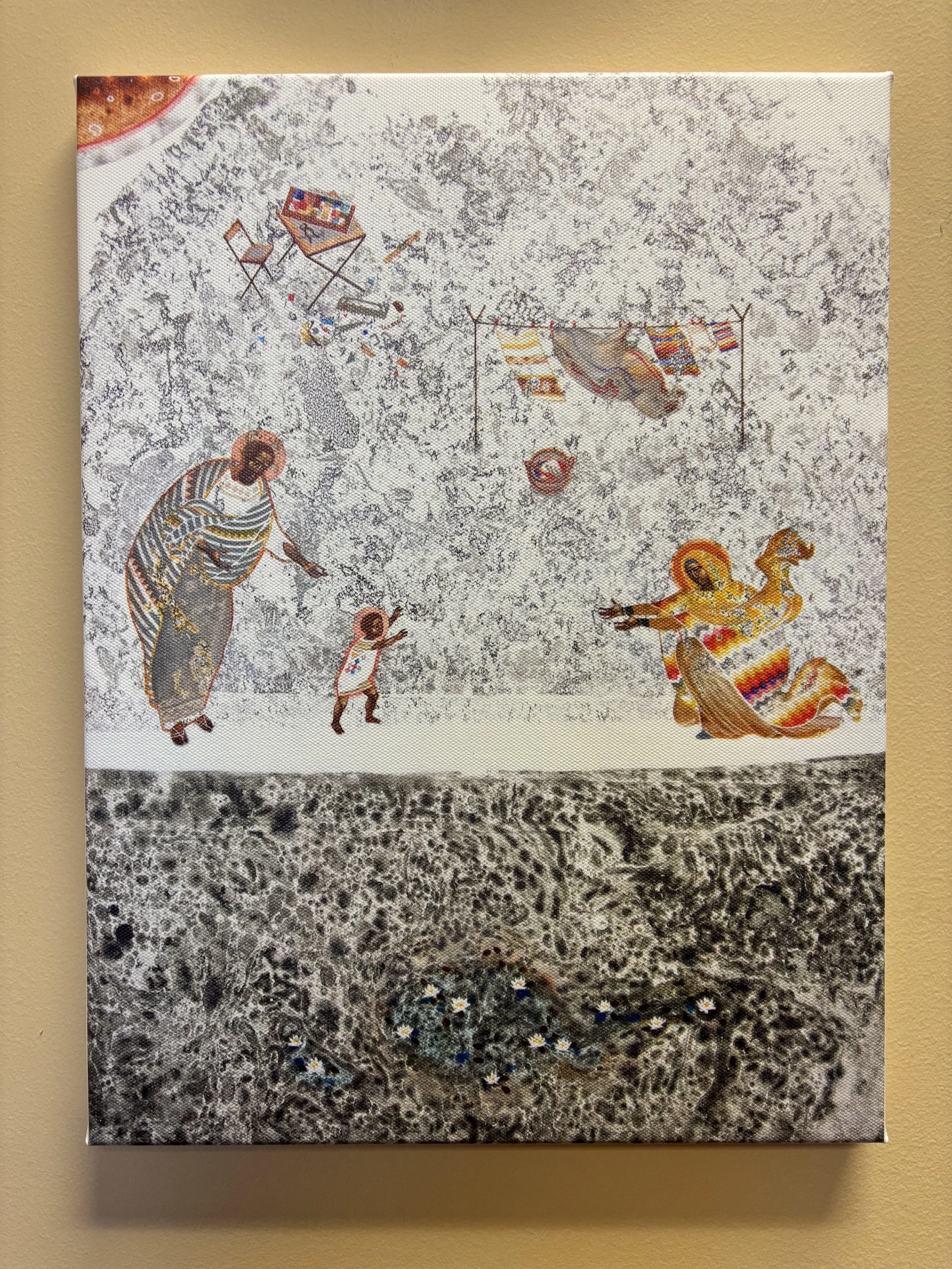
Hidden Life in Nazareth by Ivanka Demchuk
It shows they lived. It reminds me that Jesus was once a child. He had bumps and bruises. He played. He ran to His parents.
I’ve experienced those things too.
I’m thankful to believe in a God who felt the depths and smallness of human joy. I want to live in a world where people are free to run into the loving arms of their community. I believe the Church should be that place. For many, I’m not sure it has been lately.
It’s not human enough. In denying Christ His humanity, we deny it to ourselves.
God made us as humans in the beginning. He said that humans were good. I guess what I’m getting at is that humanness is a feature and a bug. Sin entered the picture through human actions. Salvation entered the picture in God becoming human. Our humanity is the problem, by way of sin, and the solution, by way of the cross. These forces of good and evil are not equivalent in power or scope.
It’s challenging to admit this. Evil feels overwhelming. When we see it in ourselves or in the world, we want it to disappear. We want an answer. Beyond evil itself, the depression, the feelings that we don’t know how to manage, the regret, there has to be a reason for all of this, right? There has to be a solution to how I feel. It is Christ.
Yet, that answer doesn’t necessarily take away those feelings in this life. In fact, those feelings serve as an entry point to a deeper relational understanding of the Christian life. You don’t have to clean yourself up before God to talk to Him. I wish I understood this more quickly.
The feelings of despair, regret, and depression are not necessarily something to overcome, but something to reframe. They are an opportunity to bring us closer to God and one another. Ronald Rolheiser writes, “Simply put, if you go to pray and you are feeling angry, pray anger; if you are sexually preoccupied, pray that preoccupation; if you are feeling murderous, pray murder; and if you are feeling full of fervor and want to praise and thank God, pray fervor. Every thought or feeling is a valid entry into prayer. What’s important is that we pray what’s inside of us and not what we think God would like to see inside of us.”
God can handle your feelings. He is big enough.
The picture of the Good Life that Christ provides us this side of heaven is a picture of our humanity. As Bonhoeffer puts it: “Behold the God who has become man, the unfathomable mystery of the love of God for the world. God loves man. God loves the world. It is not an ideal man that He loves, but man as he is; not an ideal world, but the real world.”
Bonhoeffer exposes some of the tension we see in the world. Many Christians are bewitched by ideas that run counter to the Good News we find in Jesus. Joan Didion writes, “We tell ourselves stories in order to live.” I believe we are telling the wrong story. I think the story that many are drawn to overlooks the end of the Christian story. Instead, we are drawn to the Yin-Yang-ification of Christianity, where good and evil are equal forces tussling with one another through time.
If you look at the end of the story, there’s a different reality.
Christ won. Christ is winning. Christ will win.
Yes, evil exists. We should resist its call. However, we shouldn’t give it more power than it deserves. If good and evil fight against one another as equal partners, that’s scary. I wouldn’t blame anyone for feeling afraid. There is room for fear to creep in because evil is a more worthy opponent. Thankfully, Christians don’t have to live this way.
Yet, we often do.
Fear tricks us into believing that God needs our help in defeating evil. Fear claims to offer peace through a fight. When fear guides our actions, it only multiplies division. Fear doesn’t leave any room for trust. Thus, peace will never come. This is why God’s means of defeating evil is rooted in love.
As Christians, we do not have to settle for the lived experience of the world as the only pathway for understanding life. Jacques Ellul reminds us that “The Holy Spirit gives hope where all is despair, the strength to endure in the midst of disaster, perspicacity not to fall victim to seduction, the ability to subvert in turn all the powers that are involved. Believers, then, are those who have the wisdom and strength to rob material realities of their seductive power, to unmask them for what they are, no more, and to put them in the service of God, diverting them totally from their own law.”
Christ won. Christ is winning. Christ will win. We mourn with those who mourn. The depths of our pain can reveal new life. We rejoice with those who rejoice. The smallness of our joy can become immense in light of the work of Christ. He invites us to trust that His redemptive work takes place regardless of our awareness of it. God commands us to love the world as it is, not as we wish it to be.
This is the story we should be telling. More importantly, this is the story we should be living. It is the story of God’s love. I do not find this particularly easy, but it is transforming me.
One of the more challenging aspects of being a believer today is watching people who taught me to think this way exhibit the opposite behavior. I don’t say this to attack or defend my position, nor am I trying to accuse people of not being saved by the grace of God because they do not conform to my thinking. There are various ways that our beliefs can translate into action.
We’re all a work in progress when it comes to how this looks. When we become Christians, we don’t magically fall in line. Our beliefs don’t immediately translate to Biblical positions. That’s not really how anything works. It’s a journey of transformation.
However, I do see believers that I cherish offer answers that I find hard to square when looking at the life and teachings of Jesus. The Sermon on the Mount provides the glasses with which we learn to see the world. I’d suggest that this is the most instructive and practical guide for understanding the way of Jesus versus the way of the world. Perhaps, most crucially, Jesus teaches an understanding that advocating for something that does not directly benefit ourselves will reveal how to see the people around us as precious to God.
People are precious.
People are not enemies to overcome.
People are not pawns in a plan to win.
In a world where everything is political, it’s easy to look at the teachings of Jesus and think we should sort his words into buckets of conservative or progressive thought. However, the teachings of Jesus do not conform to either side of the political spectrum. Both extremes and everything in between could feasibly claim that they are attempting to prop up their ideology on a biblical foundation. History is littered with these attempts. Some beautiful and others quite reprehensible, in hindsight.
In exploring the political implications of faith, we must resist bothsidesism and apathy, while recognizing the systems we create have flaws. Despite the noise of our current climate, politics are simply one slice of the Christian life pie. Evil exists in various contexts. We do not overcome evil by using the same means of this world in different directions. Our sense of righteousness and anger is not deified by its ability to be correct.
We overcome evil by moving toward what is good, by letting Christ transform our lives, decisions, and desires. We overcome evil by doing the things Jesus told us to do.
In short, we overcome evil through love.
Despite the cliche, there is no other way.
“‘Teacher, which commandment in the law is the greatest?’ He said to him, ‘You shall love the Lord your God with all your heart and with all your soul and with all your mind.’ This is the greatest and first commandment. And a second is like it: ‘You shall love your neighbor as yourself.’ On these two commandments hang all the Law and the Prophets.’”
Often, when looking at the Greatest Commandment, we separate the two parts from one another, as if they don’t walk hand-in-hand. The second command is alongside the first. Loving God and loving neighbor are streams flowing to and from the same ocean. They are actions, dispositions of the heart, and states of being that feed one another.
There is order, but not necessarily hierarchy. Jesus illustrates this cohesion.
Jesus’s critiques in the New Testament rarely focus on sinners. To sinners, he offers life. His criticisms center on church leaders, who offer nothing but hypocrisy to communities starving for life. The moral piety of the religious leaders masquerades as devotion to God, while the people under their authority suffer. Jesus and the prophets of the Old Testament offer story after story showing that the praise and worship we tend to lift up as crucial are nowhere near as pressing as how we treat the outcasts, the poor, and the despised in our communities.
He destroys the “us-versus-them” framework. We often live the opposite behaviors. We point the finger at culture while failing to see the individual and institutional decay that permeates many of our churches. Self-righteousness and pride hinder our faith. They are blinders of comfort that we become accustomed to over time.
We disciple people with answers to questions and fail to provide counsel on how to live in light of the good news of Jesus. Answers are clean. They offer comfort. Life isn’t a series of questions and answers in this way. Life is messy and nonlinear. Loving people is often inconvenient and inefficient. I’m grateful and lucky to have a family that helped guide me toward Jesus. I’m grateful they didn’t have all the answers or make them up because they were unsure. It helped me learn.
Sometimes, not having all the answers is the essence of faith.
I don’t intend to shame or pile on guilt with these words. I believe that, as Christians, we’re all stumbling forward. I don’t think I’ve figured it out, and everyone else hasn’t. These are more the questions I’ve pursued and the answers I’ve come up with on that journey. I’m sure it will evolve over time.
Rediscovering our humanity involves finding comfort in our flaws, discussing them in healthy communities, and our willingness to bring them to Jesus. If it’s in the open, there is a possibility for change. Living that out, holistically, is tricky.
As Pastor Mike Erre says, “The opposite of shame is connection.” If the Church wants to heal, it must find ways to connect with the world beyond a mindset of protectionism and fear of losing control.
It is not our job to be the morality police of the world.
It is our job to radically love people, as they are, into our communities.
The Church that raised me taught me this.
I hope to carry it forward.